What Command Can Be Used on a Cisco Router to View the Routing Table?

To brandish the current state of the routing table, utilize the show ip route command in user EXEC or privileged EXEC style.
The show ip route command is a powerful tool to use at this bespeak in your search. Y'all can straight examine the routing table to determine if an entry for the host exists.
The output of bear witness ip route displays the entries in the routing table, every bit well as the means past which they were determined (directly continued network, static route, or which routing protocol was used to select the route).
It also displays the Gateway of terminal resort, sometimes chosen the default Gateway, if i is configured. This is a static route configured by the user that routes IP accost 0.0.0.0. (all destinations) through a unmarried host (the Gateway) . The effect of setting a gateway is that if no routing table entry exists for a destination address, packets destined for that address will be forwarded to the Gateway router.
In the current network testing example, if you found a bespeak in the network where the path to the host breaks down, y'all would want to Telnet to the last reachable device. There you could cheque its routing table and meet if a route to the destination is nowadays.
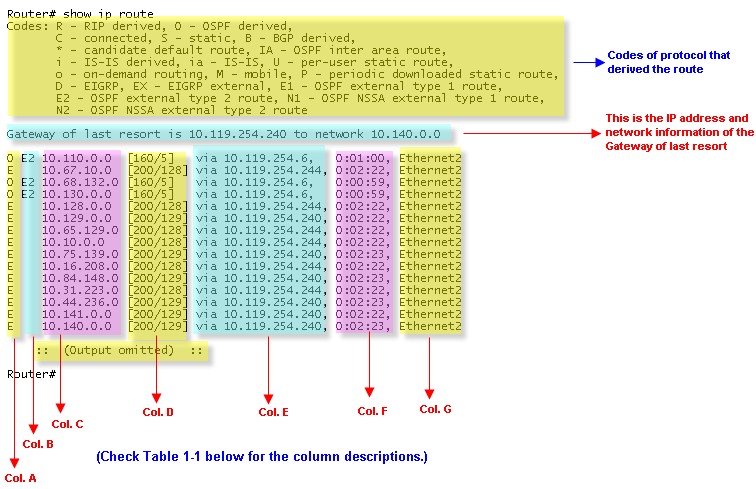
Table: prove ip route Field Descriptions
| Field | Description |
| Col. A | Indicates the protocol that derived the route. It can exist one of the following values:
|
| Col. B | Type of route. It can be one of the following values:
|
| Col. C | Indicates the address of the remote network. |
| Col. D | The first number in the brackets is the administrative distance of the information source; the second number is the metric for the route. |
| Col. E | Specifies the address of the adjacent router to the remote network. |
| Col. F | Specifies the last time the route was updated (in hours:minutes:seconds). |
| Col. G | Specifies the interface through which the specified network can be reached. |
More than Related Cisco IOS Command Reviews:
Show memory Command
Prove module command
Prove controllers control
Prove interfaces
Bear witness running-config
Cisco Testify Version Control
Peak 10 Commands Every Cisco IOS User Should Know
Configure logging in Cisco IOS
Source: https://blog.router-switch.com/2013/12/show-ip-route/
0 Response to "What Command Can Be Used on a Cisco Router to View the Routing Table?"
Post a Comment