Critical Reviews of Among the Sierra Nevada + 1868 + Bierstadt
| Albert Bierstadt | |
|---|---|
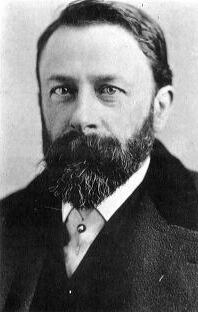 Albert Bierstadt by Napoleon Sarony | |
| Born | (1830-01-07)January 7, 1830 Solingen, Rhine Province, Germany |
| Died | February eighteen, 1902(1902-02-18) (aged 72) New York Metropolis, U.South. |
| Nationality | American |
| Education | Düsseldorf School |
| Known for | Painting |
| Movement | Hudson River School |
Albert Bierstadt (January 7, 1830 – February 18, 1902) was a German-American painter best known for his lavish, sweeping landscapes of the American W. He joined several journeys of the Westward Expansion to pigment the scenes. He was not the first creative person to tape the sites, merely he was the foremost painter of them for the rest of the 19th century.
Bierstadt was born in Prussia, but his family moved to the United states when he was 1 yr sometime. He returned to study painting for several years in Düsseldorf. He became function of the second generation of the Hudson River School in New York, an informal group of like-minded painters who started painting along the Hudson River. Their style was based on advisedly detailed paintings with romantic, virtually glowing lighting, sometimes called luminism. Bierstadt was an important interpreter of the western mural, and he is also grouped with the Rocky Mountain School.[i]
Early on life and education [edit]
Bierstadt was born in Solingen, Federal republic of germany, the son of Christina K. (Tillmans) and Henry Bierstadt, a cooper.[2] His brother was prominent photographer Edward Bierstadt. Albert was just a year old when his family immigrated to New Bedford, Massachusetts in 1831. He made clever crayon sketches in his youth and adult a taste for art.[3]
In 1851, Bierstadt began to paint in oils.[3] He returned to Deutschland in 1853 and studied painting for several years in Düsseldorf with members of its informal schoolhouse of painting. Subsequently returning to New Bedford in 1857, he taught drawing and painting briefly before devoting himself total-fourth dimension to painting.[four]
Career [edit]

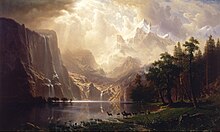
In 1858, Bierstadt exhibited a large painting of a Swiss landscape at the National Academy of Design, which gained him positive disquisitional reception and honorary membership in the Academy.[iv] Bierstadt began painting scenes in New England and upstate New York, including in the Hudson River valley. He was part of a grouping of artists known as the Hudson River School.
In 1859, Bierstadt traveled westward in the visitor of Frederick Due west. Lander, a land surveyor for the U.South. government, to see those western American landscapes for his work.[5] He returned to a studio he had taken at the 10th Street Studio Building in New York with sketches for numerous paintings he then finished. In 1860, he was elected a member of the National University of Pattern; he received medals in Austria, Bavaria, Belgium, and Deutschland.[half-dozen] [ unreliable source? ]
In 1863, Bierstadt traveled West again, this time in the company of the writer Fitz Hugh Ludlow, whose wife he later married. The pair spent seven weeks in the Yosemite Valley. Throughout the 1860s, Bierstadt used studies from this trip as the source for large-scale paintings for exhibition and he continued to visit the American Westward throughout his career.[7] The immense canvases he produced after his trips with Lander and Ludlow established him as the preeminent painter of the western American landscape.[viii] Bierstadt'south technical proficiency, earned through his study of European landscape, was crucial to his success every bit a painter of the American West and accounted for his popularity in disseminating views of the Rocky Mountains to those who had not seen them.[eight]
During the American Civil War (1861 to 1865), Bierstadt was drafted in 1863 and paid for a substitute to serve in his place. By 1862, he had completed one Civil State of war painting Guerrilla Warfare, Ceremonious War based on his brief experiences with soldiers stationed at Camp Cameron in 1861.[9] That painting was based on a stereoscopic photograph taken by his brother Edward Bierstadt, who operated a photography studio at Langley'southward Tavern in Virginia. The painting received a positive review when it was exhibited at the Brooklyn Art Association at the Brooklyn University of Music in December 1861. Curator Eleanor Jones Harvey observed that the painting, created from photographs, "is quintessentially that of a voyeur, privy to the stories and unblemished by the violence and brutality of first-mitt combat experience."[9]
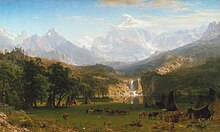
Financial recognition confirmed his condition: The Rocky Mountains, Lander'south Peak, completed in 1863, was purchased for $25,000 in 1865,[10] the equivalent of almost $400,000 in 2020.
In 1867, Bierstadt traveled to London, where he exhibited two landscape paintings in a private reception with Queen Victoria.[eight] He traveled through Europe for two years, cultivating social and business contacts to sustain the marketplace for his work overseas.[8] His exhibition pieces were brilliant images, which glorified the American West every bit a land of hope and "fueled European emigration". He painted Among the Sierra Nevada, California in his Rome studio for case, showed it in Berlin and London before shipping information technology to the U.Southward.[11] As a result of the publicity generated past his Yosemite Valley paintings in 1868, Bierstadt's presence was requested by every explorer considering a westward expedition, and he was deputed past the Atchison, Topeka, and Santa Iron Railroad to visit the 1000 Canyon for the further subject matter.[12]
Bierstadt's choice of grandiose subjects was matched by his entrepreneurial flair. His exhibitions of individual works were accompanied by promotion, ticket sales, and, in the words of 1 critic, a "vast machinery of advertisement and puffery."[xi]
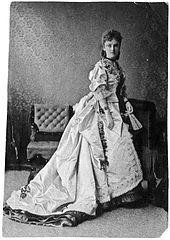
Rosalie Bierstadt, unknown date
Despite his popular success, Bierstadt was criticized by some contemporaries for the romanticism evident in his choices of subject and his use of light was felt to exist excessive. Some critics objected to Bierstadt's paintings of Native Americans on the grounds that Indians "marred" the "impression of solitary grandeur."[7]
In 1876, his wife was diagnosed with tuberculosis, and from then until her death in 1893, Bierstadt spent time with her in the warmer climate of Nassau in the Commonwealth of the bahamas. He also connected to travel to the W and Canada. In later on life, Bierstadt's work fell increasingly out of critical favor. Information technology was attacked for its theatrical tone.[8]
In 1882, a burn down destroyed Bierstadt's studio at Irvington, New York, and with it many of his paintings.[3] By the time of his death on February eighteen, 1902,[13] the gustation for epic mural painting had long since subsided. Bierstadt was then largely forgotten. He was buried at the Rural Cemetery in New Bedford, Massachusetts.[two]
Posthumous reception [edit]
Interest in Bierstadt's piece of work was renewed in the 1960s with the exhibition of his small-scale oil studies.[8] Modernistic opinions of Bierstadt take been divided. Some critics accept regarded his work as gaudy, oversized, extravagant champions of Manifest Destiny. Others accept noted that his landscapes helped create back up for the conservation motion and the establishment of Yellowstone National Park.[7] Subsequent reassessment of his work has placed it in a favorable context, every bit stated in 1987:
The temptation (to criticize him) should be steadfastly resisted. Bierstadt's theatrical art, fervent sociability, international outlook, and unquenchable personal free energy reflected the epic expansion in every facet of western civilization during the 2nd half of the nineteenth century.[14]
Bierstadt was a prolific artist, having completed over 500 paintings during his lifetime.[15]
Existing work [edit]
- 1853 – Majesty of the Mountains
- 1855 – The Old Factory
- 1855 – The Portico of Octavia
- 1855 – Westphalia
- 1858 – Lake Lucerne, c. 1853, oil on canvass, National Gallery of Art, Washington, D.C.
- 1859 – The Wolf River, Kansas,[xvi] c. 1859, oil on canvass, Detroit Institute of Arts, Detroit, Michigan
- 1861 – Echo Lake, Franconia Mountains, NH,[17] Smith Higher Museum of Art,[18] Smith College, Northampton, Massachusetts
- 1863 – The Rocky Mountains, Lander's Peak, oil on canvas, Metropolitan Museum of Fine art, New York City, New York
- 1864 – Cho-looke, the Yosemite Fall, oil on canvas, Timken Museum of Art, San Diego, California[19]
- 1864 – Valley of the Yosemite,[20] oil on paper, Museum of Fine Arts, Boston, Massachusetts
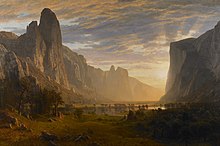
- 1865 - Looking Down Yosemite Valley,[21] Birmingham Museum of Art, Alabama
- 1866 – Yosemite Valley,[22] Oil on canvass on panel-dorsum stretcher, Cleveland Museum of Art, Cleveland, Ohio
- 1866 – On the Hudson River Virtually Irvington, 1866–seventy, oil on paper, Berkshire Museum, Pittsfield, Massachusetts
- 1866 – A Storm in the Rocky Mountains, Mt. Rosalie, oil on canvas, Brooklyn Museum, New York City, New York
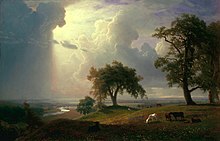
- 1868 – Connecticut River Valley, Claremont, New Hampshire, 1868, oil on canvass, Berkshire Museum, Pittsfield, Massachusetts
- 1868 – In the Sierras,[23] Fogg Museum, Harvard University, Cambridge, Massachusetts
- 1868 – Among the Sierra Nevada, California,[24] Smithsonian American Art Museum, Washington, D.C.
- 1869 – Glen Ellis Falls, oil on canvas, Zimmerli Art Museum, New Brunswick, New Jersey
- 1870 - Sierra Nevada Morning, oil on canvas, Gilcrease Museum, Tulsa, Oklahoma
- 1870 – Puget Audio on the Pacific Declension,[25] oil on sail, Seattle Art Museum, Seattle, Washington
- 1871 – Domes of Yosemite,[26] c. 1871, St. Johnsbury Archives, St. Johnsbury, Vermont
- 1874 – Behemothic Redwood Copse of California, c. 1874, oil on sheet, Berkshire Museum, Pittsfield, Massachusetts
- 1875 – Mountain Adams, Washington, 1875, oil on canvas, Princeton University Art Museum, Princeton, New Jersey
- 1876 – Mount Corcoran,[27] c. 1876–77, oil on canvas, Corcoran Gallery of Fine art, Washington, D.C.
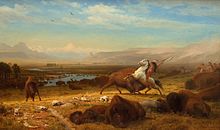
- 1888 – The Terminal of the Buffalo,[28] oil on canvas, Corcoran Gallery of Art, Washington, D.C.
- 1889 – Alaskan Coast Range,[29] c. 1889, Smithsonian American Art Museum, Washington, D.C.
- 1891 – The Last of the Buffalo,[30] c. 1891, vintage photogravure, Valley Fine art Gallery, Aspen, Colorado
- 1895 – The Morteratsch Glacier Upper Engadine Valley – Pontresina
Selected paintings [edit]
-

-

Staubbach Falls, Near Lauterbrunnen, Switzerland, 1865
-

-

-

-

-

Indians Spear Fishing, 1862
-
-
-

-

-
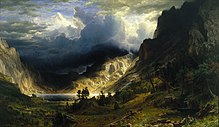
Tempest in the Rocky Mountains, Mount Rosalie (1866), Brooklyn Museum, New York
-
-

Light in the Forest, unknown date
-

-
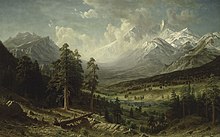
Estes Park, Long's Superlative, 1877, Denver Fine art Museum (on loan from the Denver Public Library)
-

Emerald Sea (or The Shore of the Turquoise Bounding main), 1878, Manoogian Collection, Detroit, U.Due south.
-

Legacy and honors [edit]

- Because of Bierstadt'due south involvement in mount landscapes, Mount Bierstadt and Bierstadt Lake in Colorado are named in his honor. Bierstadt was probably the starting time European to visit the summit of Mount Evans in 1863, 1.5 miles from Mountain Bierstadt.[31] Bierstadt named it Mount Rosa, a reference to both Monte Rosa above Zermatt and, Rosalie Ludlow, his time to come wife, but the proper noun was changed from Rosalie to Evans in 1895 in honor of Colorado governor John Evans.
- In 1998, the United States Post issued a set of 20 commemorative stamps entitled "Four Centuries of American Art", one of which featured Albert Bierstadt'southward The Concluding of the Buffalo.[32] In 2008, the USPS issued a commemorative postage stamp in its "American Treasures" serial featuring Bierstadt'south 1864 painting Valley of the Yosemite. [33]
- William Bliss Bakery, some other mural creative person, studied nether Bierstadt.
References [edit]
- ^ "Picturing America's Natural Cathedrals". Tfaoi.com. Retrieved May 20, 2012.
- ^ a b Garraty, John Arthur; Carnes, Marker Christopher; Societies, American Council of Learned (March 29, 1999). American National Biography: Bakery-Blatch. Oxford University Press. ISBN9780195127812 – via Google Books.
- ^ a b c Wilson, J. Thousand.; Fiske, J., eds. (1900). . Appletons' Cyclopædia of American Biography. New York: D. Appleton.
- ^ a b "Artist Info". nga.gov.
- ^ Mount Corcoran National Gallery of Art, retrieved September 14, 2018
- ^ Reynolds, Francis J., ed. (1921). . Collier's New Encyclopedia. New York: P. F. Collier & Son Company.
- ^ a b c Hassrick, Peter H. (Leap 2018). "Fine art, Agency, and Conservation: A Fresh Expect at Albert Bierstadt'south Vision of the West". Montana The Magazine of Western History. 68 (1).
- ^ a b c d e f "Bierstadt, Albert", National Gallery of Art. Retrieved February 2, 2018.
- ^ a b Harvey, Eleanor Jones (2012). The Civil War and American Fine art. Smithsonian American Art Museum; Metropolitan Museum of Art. Yale University Press. ISBN978-0-300-18733-5.
- ^ "Albert Bierstadt: The Rocky Mountains, Lander's Peak (07.123) – Heilbrunn Timeline of Fine art History – The Metropolitan Museum of Art". metmuseum.org.
- ^ a b "Amid the Sierra Nevada, California past Albert Bierstadt / Exhibition Characterization". Smithsonian American Fine art Museum. 2006.
- ^ Barringer and Wilton, 250
- ^ Chisholm, Hugh, ed. (1911). . Encyclopædia Britannica. Vol. three (11th ed.). Cambridge University Press.
- ^ Howat, John 1000., editor. American Paradise: The Earth of the Hudson River School, 284. Metropolitan Museum of Art, New York, 1987. ISBN 9780870994975
- ^ Glenda Moore (September 9, 2004). "xmission.com". xmission.com. Retrieved December 19, 2012.
- ^ "Albert Bierstadt: The Wolf River, Kansas (61.28) — The Detroit Found of Arts". Dia.org. Archived from the original on February 23, 2009. Retrieved July 5, 2013.
- ^ "Echo Lake, Franconia Mountains, New Hampshire / Due north American / Art of the Americas / Highlights By Category / Collection Highlights / Collections / Smith College Museum of Fine art – Smith Higher Museum of Art". Scma.smith.edu. Archived from the original on March 22, 2012. Retrieved July five, 2013.
- ^ "Domicile / Smith Higher Museum of Art – Smith College Museum of Art". Smith.edu. Retrieved July 5, 2013.
- ^ "Cho-looke, the Yosemite Autumn, 1864". Timken Museum of Art. Archived from the original on February 21, 2009.
- ^ "Valley of the Yosemite". Retrieved May 31, 2014.
- ^ {{cite web |title=Valley of the Yosemite |url=https://en.wikipedia.org/wiki/Valley_of_the_Yosemite
- ^ "Yosemite Valley". October 31, 2018.
- ^ "In the Sierras". Harvard Art Museums. Retrieved July v, 2013.
- ^ "Among the Sierra Nevada, California". Smithsonian American Art Museum. Archived from the original on June 1, 2014. Retrieved May 31, 2014.
- ^ "Puget Sound on the Pacific Declension". Seattle Art Museum. Archived from the original on August one, 2017. Retrieved July 31, 2017.
- ^ "St. Johnsbury Athenaeum>>This Calendar week from the Gallery Archives". Stjathenaeum.org. Archived from the original on September 27, 2013. Retrieved July five, 2013.
- ^ "Mount Corcoran | Corcoran". Collection.corcoran.org. Archived from the original on May eighteen, 2013. Retrieved July 5, 2013.
- ^ "The Final of the Buffalo | Corcoran". Drove.corcoran.org. Archived from the original on May 18, 2013. Retrieved July 5, 2013.
- ^ "Alaskan Coast Range". Smithsonian American Art Museum. Archived from the original on May ii, 2014. Retrieved May 31, 2014.
- ^ "Valley Fine art". Valley Fine Fine art Gallery. Retrieved March ii, 2015.
- ^ William Newton Byers, Bierstadt's Visit to Colorado: Sketching for the famous painting, "Storm in the Rocky Mountains", Magazine of Western History, Vol. xi, No. iii, Jan. 1890; folio 237-240.
- ^ "ArtOnStamps.org". ArtOnStamps.org. July ix, 2010. Retrieved May twenty, 2012.
- ^ "The Postal Store @ USPS.com". Store.usps.com. March 28, 2011. Retrieved May xx, 2012.
Further reading [edit]
- Anderson, Nancy K. et al. Albert Bierstadt, Fine art & Enterprise, New York: Hudson Hills Press, 1990.
- Barringer, Tim and Wilton, Andrew. American Sublime: Landscape Painting in the United States 1820–1880, Princeton Academy Press, 2002. ISBN 0-691-09670-8.
- Hendricks, Gordon. Albert Bierstadt, Painter of the American West, New York: Harrison Firm/Harry North. Abrams, Inc., 1988.
- American Paradise: The World of the Hudson River School . New York: The Metropolitan Museum of Art. 1987. ISBN9780870994968.
- Miller, Angela. "Albert Bierstadt, Landscape Aesthetics, and the Meanings of the West in the Civil War Era". Art Found of Chicago Museum Studies 27, no. ane (Terrain of Liberty: American Art and the Civil State of war) (2001): 40–59 and 101–102. doi:ten.2307/4102838. JSTOR 4102838.
External links [edit]
- Works by or about Albert Bierstadt at Internet Archive
- Albert Bierstadt (albertbierstadt.org)
- Albert Bierstadt Paintings at fineartamerica.com
- White Mountain paintings by Albert Bierstadt
- A finding assistance to the Albert Bierstadt letter of the alphabet collection, 1880–1893 in the Archives of American Art, Smithsonian Institution
- "Against His Grain: Albert Bierstadt'south 'Clouds Over the Prairie'" MONA Moment, Museum of Nebraska Art
- Gallery of Bierstadt's Paintings
- The Winterthur Library—Overview of an archival drove on Albert Bierstadt.
- Albert Bierstadt Paintings Gallery—345 images online
- Albert Bierstadt'southward Biography at The R.W. Norton Fine art Gallery
- "'Giant Redwood Copse' will fall at Berkshire Museum despite interpretive value", The Berkshire Eagle, June thirty, 2018
- Albert Bierstadt, WikiArt
- Albert Bierstadt at Find a Grave
Source: https://en.wikipedia.org/wiki/Albert_Bierstadt
0 Response to "Critical Reviews of Among the Sierra Nevada + 1868 + Bierstadt"
Post a Comment